Laser-induced breakdown spectroscopy calibration accuracies compared among four instruments, three atmospheres, and eight laser powers for 74 elements using 2157 geochemical standards.
Cai R. Ytsma, M. Darby Dyar, & Kate Lepore (2026)
Spectrochimica Acta Part B: Atomic Spectroscopy, volume 243, article 107571
This publication showcases a decade of geochemical research with LIBS.
Darby, Kate and I have optimized methods for accurately predicting geochemistries using LIBS spectra of powdered rock standards, investigating how a slew of variables can affect these accuracies, and providing recommendations for best practice in a variety of contexts.
I joined the Mineral Spectroscopy Lab at Mount Holyoke College in 2016, when I was an undergrad at Smith College. I began my first research experience by analyzing some of these 2000+ samples in the laboratory LIBS instrument designed to mimic the ChemCam instrument on Mars rover Curiosity. At the time, Kate was the laboratory manager in charge of collecting data and maintaining the instrument, and Darby was my advisor.
I began my own research project in the summer of 2016 - quantifying hydrogen, the most difficult element to measure in rocks with LIBS - and first-authored its publication in Spectrochimica Acta B before graduation. My undergraduate thesis - quantifying further light elements in multiple acquisition conditions - was published as a postgrad, and is currently my highest cited spectroscopy publication.
Over the years, we analyzed our 2000+ standards under Earth, Mars, and vacuum conditions, we collborated with Goddard Space Flight Center and SciAps on analyzing our data with handheld instruments, Kate built a new LIBS instrument to mimic the SuperCam instrument on Mars rover Perseverance, and Darby’s mentorship helped me discover my strength and interest in data science and engineering methods, as applied to our research. I quickly became Darby’s right-hand data guru, and familiarized myself with the skills required to appropriately collect, store, preprocess, and utilize large datasets for research using custom pipelines.
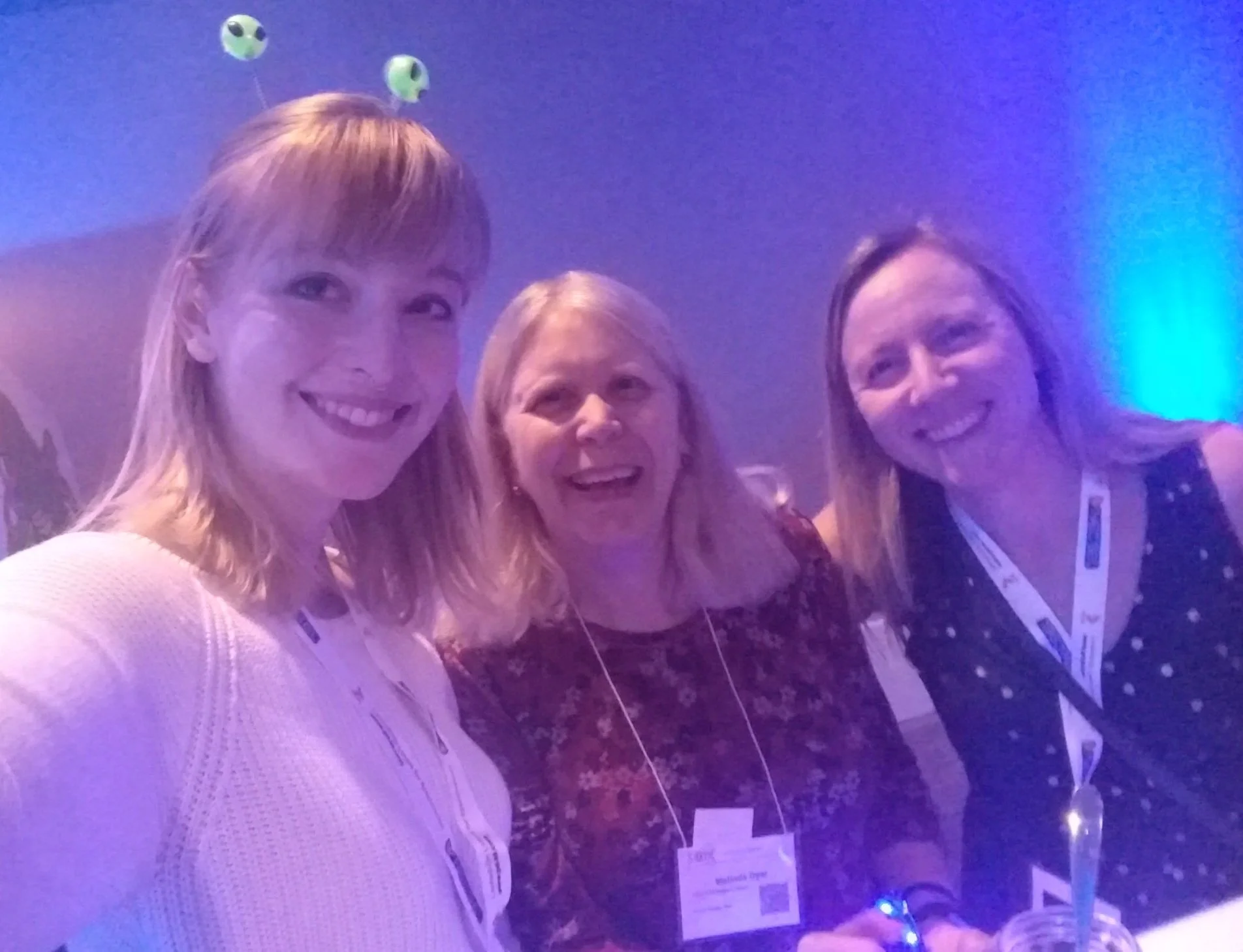
Cai, Darby, and Kate at the 2018 SciX conference in Atlanta, Georgia.
Our publications used our advantageously large datasets to uncover systematic differences in modelling methods, dataset preprocessing, quantification limits, acquisition conditions, and more through the lens of elemental prediction accuracies. (See Table 1 in this paper for a summary of our lab’s work)
We have presented our work at a variety of meetings and conferences, mentored more than a dozen undergraduate students’ research projects, supported Ph.D. students, and collaborated with groups worldwide. This paper is a culmination of the best practices we have determined along the way via almost 60,000 spectra (~6000 channels each), 2200 standards, four instruments, three acquisition atmospheres, and eight laser powers. Now that’s what I call big data!
I am proud to be the head data honcho for this prolific all-female team and am looking forward to seeing how other research groups use our publicly-available datasets to push the wheel of scientific knowledge even further.